For the past two decades, the goal of a small business website was simple: act as a digital brochure. You wanted a human to search for you on Google, click your link, look at your photos, and call your number.
In 2026, that model is breaking.
We are witnessing the “Click Collapse.” As Artificial Intelligence (AI) becomes the primary way people find information, users are clicking fewer links. Instead, they are getting direct answers from tools like ChatGPT, Google Gemini, and Perplexity. This shift has led many business owners to ask: Is a website still worth the investment?
From SEO to GEO: The New Rules of Visibility
The answer is yes—but not for the reasons you think. Your website is no longer just a destination for human eyes; it is a database for AI minds. It is the “source of truth” that verifies you exist, confirms what you do, and allows AI agents to hire you on behalf of their human users.
For years, businesses obsessed over Search Engine Optimization (SEO)—trying to rank #1 on Google. Today, we are moving toward Generative Engine Optimization (GEO).
GEO isn’t about ranking a link; it’s about being cited as the answer. When a user asks an AI, “Who is the best electrician for a panel upgrade in my area?”, the AI doesn’t just look for keywords. It looks for trusted facts. It builds a composite picture of your business based on data.
If your website is just a collection of pretty pictures and vague marketing text, the AI cannot “read” it. To be visible in 2026, your website needs to speak the language of machines.
Speaking “Robot”: The Technical Essentials
To survive in this new economy, your website must adopt two critical technical standards:
- Schema Markup: This is code that sits behind your website content and tells the AI exactly what it is looking at. Instead of just writing “We do massages,” you use Schema to tell the AI: Service = Deep Tissue Massage; Price = $120; Duration = 60 Minutes. This allows the AI to match your service precisely to a user’s request.
- The llms.txt File: Think of this as a resume for robots. It is a simple text file on your website that strips away all the design and code, providing AI crawlers with a clean, hallucination-free summary of your business, services, and pricing. It ensures the AI gets your facts right.
Real-Life Example: The Trade Professional (Roofer)
Let’s look at how this plays out in the trades, where trust is the most valuable currency.
The Scenario: A homeowner discovers a leak during a storm. They ask their AI assistant, “Find me a reliable roofer who can fix slate tiles.”
The Old Website (The Invisible Business): “Bob’s Roofing” has a nice website with stock photos of happy families and a generic list of services. The AI scans it but cannot find definitive proof of “slate tile repair” expertise or verification of recent local work. Bob is ignored.
The AI-Ready Website (The Verified Pro): “Apex Roofing” has a modern site optimized for Visual Search.
- Visual Proof: They don’t use stock photos. They upload “before and after” images of actual slate repairs.
- Metadata: These images are tagged with GPS coordinates and Schema data that tells the AI: Task = Slate Repair; Location = [City Name]; Date = October 2025.
- Result: The AI “sees” this data as verified proof of competence. It recommends Apex Roofing because it has high confidence that they can actually do the job.
Real-Life Example: Personal Care (Salon & Spa)
In the beauty and wellness industry, the challenge is balancing “vibe” with data.
The Scenario: A user asks, “Find a salon that offers curly cuts and uses organic products.”
The Old Website: A beautiful, artistic website with a PDF menu that you have to download. The AI cannot easily read the PDF. It misses the specific detail about “organic products.”
The AI-Ready Website: The site is still visually stunning for human visitors, but the “Service Menu” is built with structured data.
- Granular Detail: Each service is listed as a distinct data point. “Curly Cut” is explicitly defined. “Organic Product Line” is tagged as a product attribute.
- Vibe Check: The site includes video testimonials and high-quality content that feeds the AI’s understanding of the salon’s “entity authority”—basically, its reputation in the neighborhood.
- Result: The AI matches the user’s specific constraints (curly + organic) directly to the salon’s structured data.
The Website as a Digital Employee
The most exciting shift in 2026 is operational. Your website is no longer a passive brochure; it is an active employee.
We are entering the age of the “Agentic Web,” where AI agents talk to other AI agents. A customer’s AI might contact your business’s AI to negotiate an appointment time.
- 24/7 Booking: Modern websites integrate AI booking agents that can handle complex scheduling inquiries at 2 a.m. If a user asks, “Do you have any openings next Tuesday morning?”, the AI agent checks the calendar and books the slot instantly.
- Lead Qualification: Instead of a generic contact form, an AI chat agent can ask, “Is this for a residential or commercial project?” and qualify the lead before you ever have to pick up the phone.
The Risk of Rented Land
Finally, you might ask: Why not just rely on my Google Business Profile or Facebook page?
That is “rented land.” Platforms change their algorithms, suspend accounts, and hide businesses without warning. In an era of AI fragmentation—where people might search on ChatGPT, Apple Intelligence, or Google—you cannot rely on a single platform.
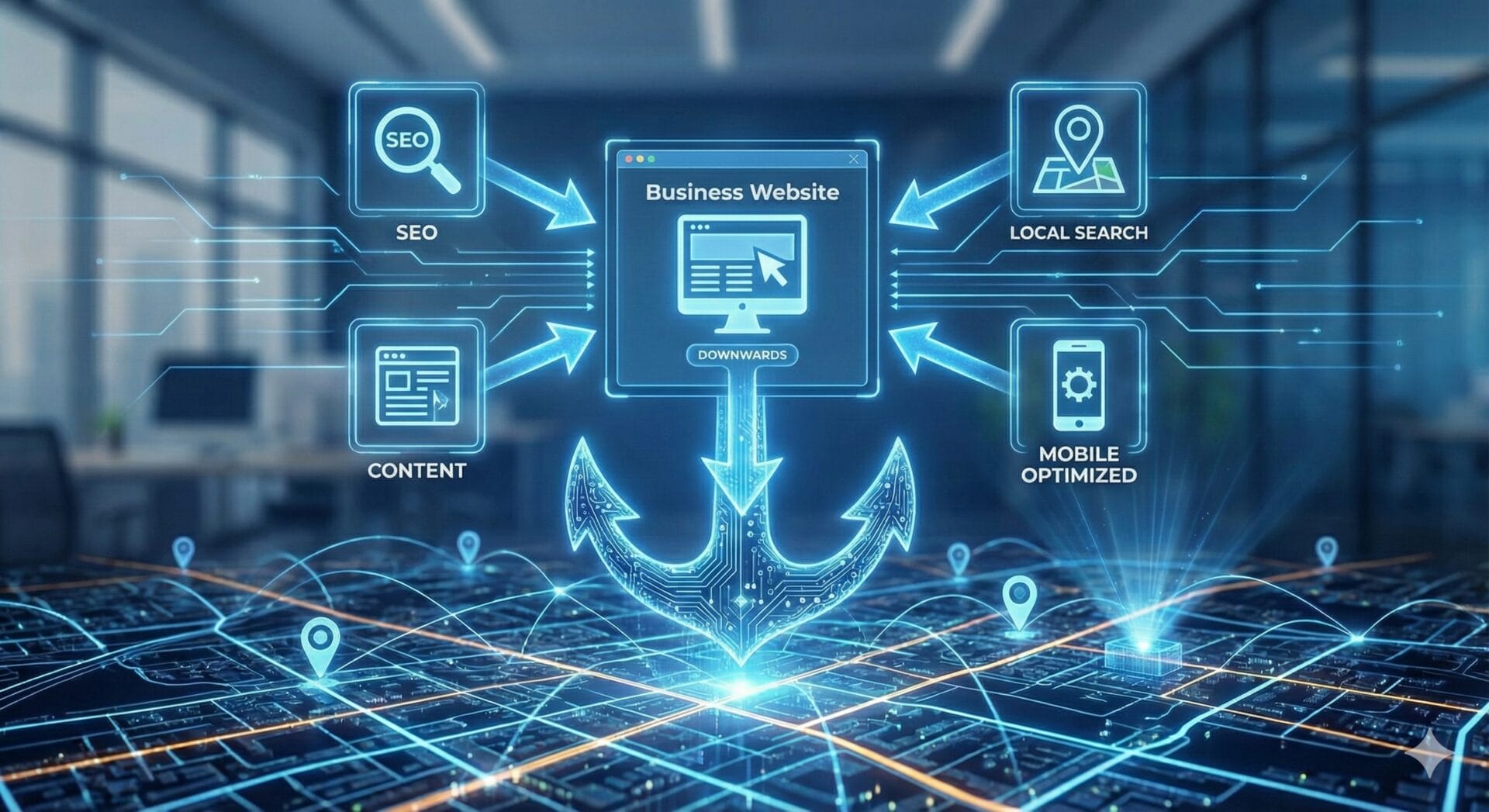
Your website is the only piece of digital real estate you truly own. It is your “Digital Anchor.” It holds your reputation, your customer data, and your verified facts steady, regardless of which AI model is trending this week.
Conclusion
The website isn’t dead; it has just been promoted. It has graduated from a marketing flyer to a critical business infrastructure. By investing in a website that is structured for machines and designed for humans, you ensure that no matter how technology evolves, your business remains visible, verified, and open for business.